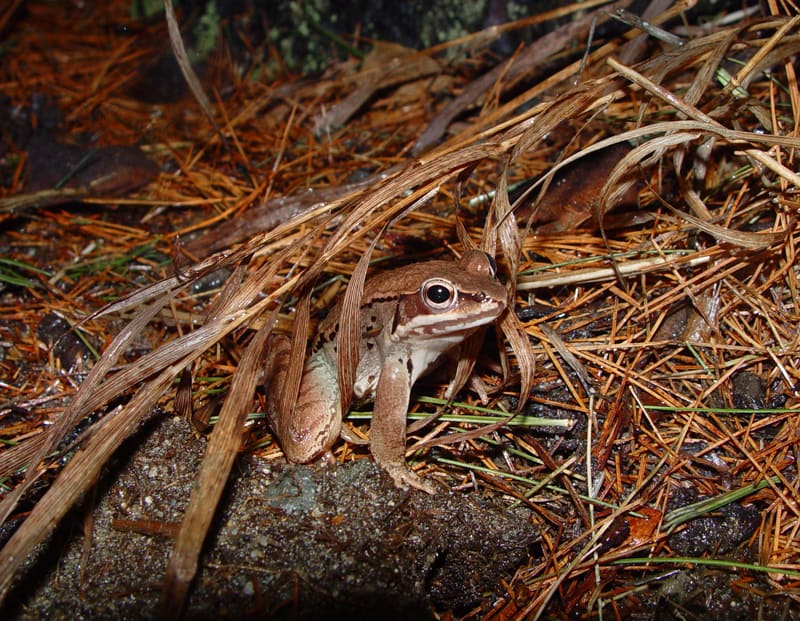
Wood Frog by Suzanne Niles
Spring has sprung in a way typical of New England: on and off rain, alternating warm and cold days, occasional spits of snow. This is the time of year that amphibians most love. On rainy nights at the end of March or early April that are 40 degrees or above, frogs and salamanders emerge from their winter hibernation, and respond to the mating urge. They are called by memory to travel to the places of their birth.
Wood frogs and mole salamanders return to their natal vernal pools. Vernal pools are relatively shallow, isolated pools. These pools usually dry up in the summer. The advantage of vernal pools to wood frogs and salamanders is that vernal pools harbor no fish which could eat their eggs.
In winter, wood frogs hibernate under wet leaves in the forest, and survive in a frozen state through a complicated chemical process—frogsicles! When the first warm rains hit them they seemingly miraculously “melt” and return to their normal state. When reaching their vernal pool, males start to call. Their croaks are low and sound like quacking ducks. They are calling both to establish territory in the pool, and to call a mate. Once mating is accomplished, females deposit a large egg mass, usually partially attached to brush or branches in the pool. Many wood frog egg masses may be put in the same area until a large, extended mass can be seen floating on the pond’s surface.
Mole salamanders also breed in vernal pools. These animals spend most of their lives in damp holes deep underground (hence the name “mole” salamander). The most common of these mole salamanders is the Spotted Salamander, a 5-7” long, sturdy, shiny black salamander with bright yellow spots. As with wood frogs, spotted salamanders emerge from hibernation on the first rainy night in late March or early April when temperatures reach at least 40 degrees. They too, migrate to the vernal pool of their birth. If conditions are perfect, spotted salamanders and wood frogs may all migrate to their vernal pools on one particular night. This phenomenon is known as “Big Night”. Spotted salamanders deposit their eggs in small, compact bundles. The eggs are enclosed in a transparent, white, or greenish sack that is attached underwater to a branch.
Its fun to shine a flashlight into a vernal pool to try to see these animals at night, and then to look for egg masses a few days later during the day. Eggs will hatch a few weeks later, and the tadpoles and larval salamanders can be seen swimming in the pool during the day. These babies will feed and grow up to their adult form within two months, and then leave the pool as adults, continuing the circle of life.
Here’s a haiku I wrote about the first day of spring:
Sun, blue sky, windy
Titmouse, nuthatch, red-wing sings
Waiting for wood frogs!
—————————-
Many thanks to all flora and fauna reporters for the month of March. Please send reports by April 30 for inclusion in next month’s column. You can write me at 7A Old Colony Drive, call me at 692-3907, or e-mail me at mariancharman@gmail.com
March Reports:
Marian/Bill Harman, Old Colony Drive. March 1, sunny, 38 degrees. I needed to get our today as much as I need food and water! There is an avian orchestra now, everybody singing or drumming! House finches, goldfinches, chickadees, titmice, nuthatches red-bellied woodpecker calling and drumming, Carolina wren, song sparrow (first heard), cardinal, red-winged blackbirds, jays (all their myriad calls), crows, ravens, deer tracks seen going out onto the pond ice. I see where a deer gracefully leaped over a log, as oppose to how I awkwardly clambered over. March 4, four inches snow on ground, tracks: fisher, smaller weasel, small, medium, large deer, turkeys. A beautiful orange jelly fungus growing on a fallen log. March 5, 32 degrees, snow again. I bundle up and go out, nose dripping. The woods is like a concert hall with all the birds singing. Two red-tails burst from a tree just a few feet away. A haiku: Hundreds of Blackbirds/Call from the tops of swaying trees/ Music to my ears. At 5 pm, two tom turkeys flew up into the trees in our back yard. March 8, 30’s, cloudy. Juncos still here, pileated woodpecker heard. March 11, 30’s, windy, a few snow flurries. Two pileated woodpeckers. One has a rapid call and loud drumming, the second answering with calls that sound like a horse’s whinny—a privilege to see and hear. A pair of wood ducks fly overhead with a high pitched call. A haiku: Plaintive cries aloft/Wood duck pair flies over/Love is in the air. March 12, daylight savings time! Forty-five degrees, still air, sunny—the calm before the storm? A big storm is moving in tomorrow night. A walk to the meadow: Lots of skunk cabbage flowers are up in the wetlands. Tracks: fisher, skunk and all sizes of deer. A haiku: Deep red hoods push up/through the cold mud; my how brave!/First flower of spring. March 14, 34 degrees and snowing. Huge one inch snowflakes drifting by or driving hard. We lose power. Tracks on the trail: deer, fisher, coyote. I hope I haven’t disturbed the ancient ones, the birds, mammals and trees. I feel fortunate to become a part of the forest. A pair of bluebirds visited the feeder, a rare treat! A haiku: Huge, fluffy snowflakes/like emptying a pillow/Feathers blown by wind. March 15, windy Ides of March! Bluebirds waiting for a turn at the shelled sunflower feeder. March 22, a walk on Mass Electric line by old highway garage: Two ravens talking to eachother in a tree by the trail. I named them “Ravena and Ravenhurst”. I have seen them here often, flying overhead or perched on the roof of the salt shed. Lots of painted turtles basking on logs in Stony Brook. American tree sparrow picking up gravel. March 24, lots of juncos—maybe moving through on migration north? One peeper and two wood frogs heard in the wetland. A pair of wood ducks in the brook, didn’t see me amazingly, and didn’t take off. March 26, fifty degrees and sunny. Yellow catkins are hanging from yellow birch branches now. On Keyes pond, Some migrating ducks taking a rest: one goldeneye, four Eurasian wigeons, six ring-necked ducks, one great blue heron flew onto the shore. March 28, cloudy and wet, 40’s. Goldfinches are bright yellow now. A few wood frogs and peepers heard, red-tailed hawk seen.
Tom Ennis, Almeria Drive. March 9, a woodcock is displaying tonight! March 12, At Acker Land in Stony Brook: two otters playing and squeaking, rubbing against each other. They were quite shy and dove down when they saw me.
Alden Wood, March 15. A bear took down the feeder.
Diane Duane, Howard Rd., March 18, a fox in the yard. Ten female turkeys seen off of Magnolia Drive.
Marian Harman is a member of the Westford Conservation Trust, a non-profit conservation organization, whose purpose is the preservation of Westford’s open spaces and trails. Check out the Trust’s website at westfordconservationtrust.org and visit us on Facebook.
Westford Conservation Trust Annual Meeting – Wednesday, November 16th, 2022 at 7 pm at Parish Center for the Arts (PCA), Westford Center Members and friends are invited to join us for our our Annual Trust Meeting. We will have a brief Trust business meeting followed by our guest speaker. Hope you can join us! Guest…
Where Are All the Birds? Where are all the birds? Many people have mentioned that their feeders seem bereft of birds. Our feeders, too, are attracting very few takers this fall. This is a pattern we see every year. At this time of year, there is a great deal of natural food available to the…
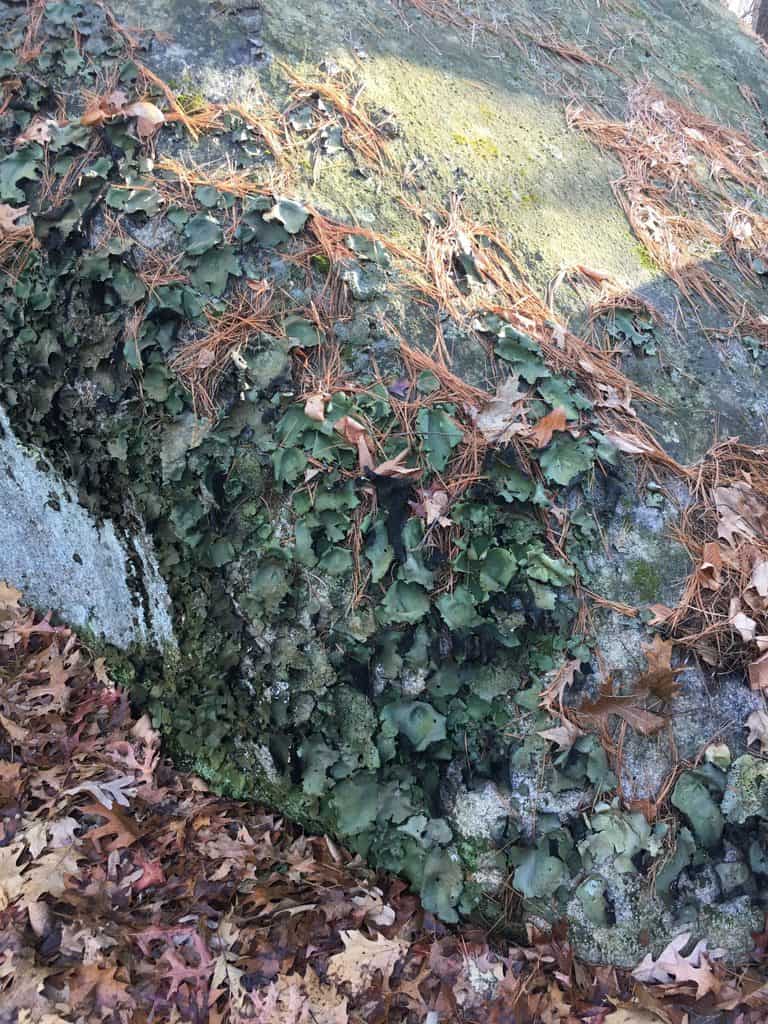
In late fall and winter when most plants are dormant, lichens are still growing. You have probably noticed lichens on trees, rocks and even tombstones. Lichens can survive and grow in conditions of extreme cold and dryness, even in parts of Antarctica. Lichens are a curious combination of a green algae and a fungus. They…
If you are trying to tread lightly on the earth, and reduce your carbon footprint, one of the most effective steps you can take is to eliminate palm oil from your life. Palm oil is cheap to produce and is shelf-stable, so is the oil of choice for many companies. But, palm oil production has…
Did you know that many female birds sing? I didn’t, but read about the phenomenon in the summer issue of Living Bird. I had heard about the female rose-breasted grosbeak sometimes singing from the nest, and some years ago I witnessed this phenomenon. I heard the singing, assumed it was a male rose-breasted grosbeak and…
Birders often refer to little brown birds as LBB’s or LBJ’s (“little brown jobs”). They can be extremely confusing to identify, but seeing them at your bird feeder gives you a chance.The LBB’s we most often see at feeders in Westford are the sparrows: Song Sparrows, American Tree Sparrows, and Chipping Sparrows. True sparrows have…
Welcome to Westford Conservation Trust’s Development and Testing Site
We are testing ideas for a refresh of our website here. If you want to see current news and events, join us as a member, or see other information on our live website, please visit https://westfordconservationtrust.org